Mold After Water Damage South Salt Lake: Why You Must Act Fast
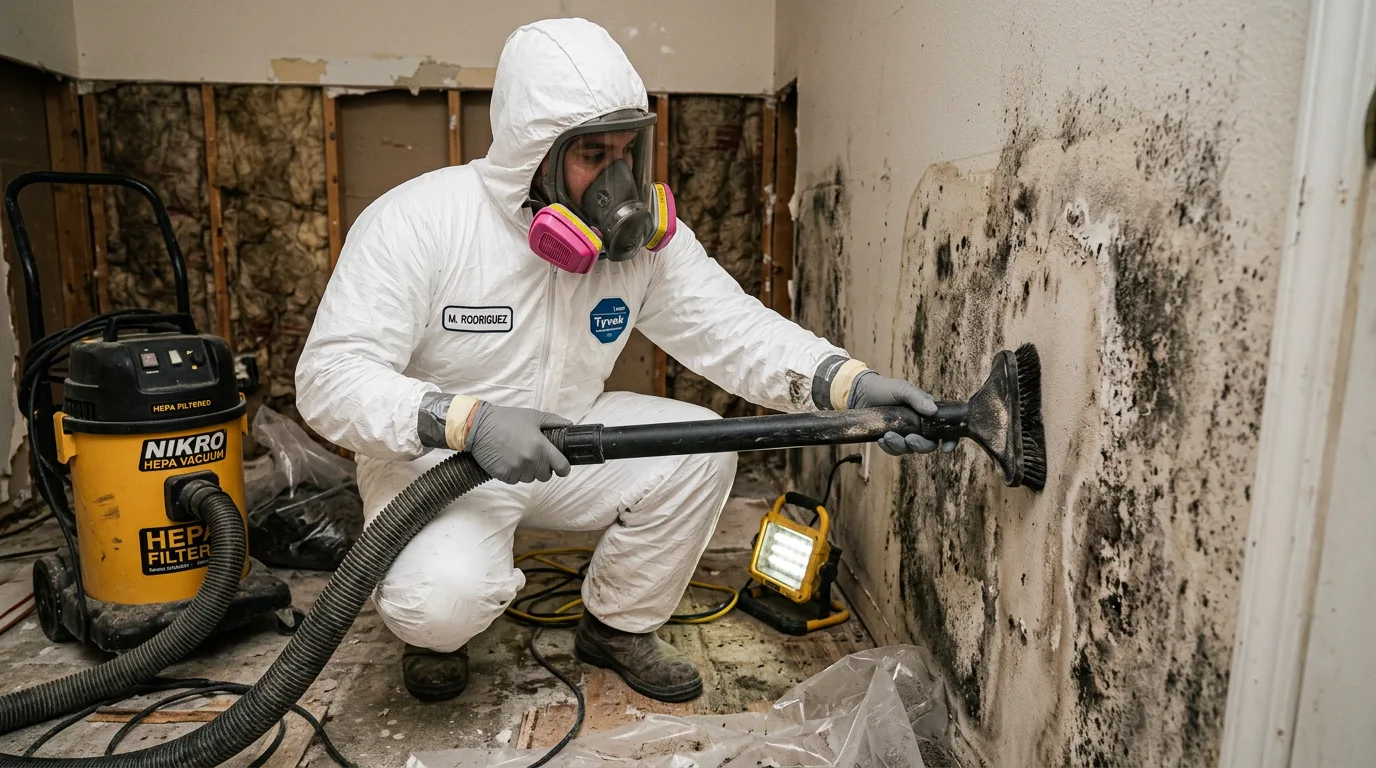
The homeowner who calls us three days after discovering a basement flood — because they thought the water was drying on its own — almost always has mold. The homeowner who calls within the first hour almost never does. That gap — the 24 to 48 hours between water contact and mold establishment — is the single most important timeline fact every South Salt Lake homeowner should understand about water damage and mold. This post explains why mold establishes so readily after water damage in South Salt Lake’s climate, what it costs to address it, and how to prevent it from the moment water enters your home.
Mold Inspection After Water Damage — South Salt Lake
IICRC AMRT-certified mold inspection and remediation. Free assessment. Call (877) 698-1311.
Why Mold Establishes So Quickly After Water Damage in South Salt Lake
Mold spores are present in every indoor environment in Salt Lake County — they’re airborne constantly at low concentrations that cause no harm. What mold needs to transition from dormant spores to active growth is moisture above a threshold moisture content in an organic material. Drywall paper, wood framing, insulation facing, and carpet backing all reach that threshold rapidly when wetted. In South Salt Lake’s climate — where spring and summer relative humidity in enclosed basement spaces can remain elevated for weeks after a water event — the conditions for mold growth persist long after visible water appears to have dried.
The South Salt Lake homeowner’s practical challenge is that most of the moisture driving mold growth is not visible. The drywall surface may appear dry while the paper facing on the back side — the surface mold colonizes — remains above threshold moisture content. The wood framing behind the drywall may be above the 19% moisture content at which mold actively grows for weeks after surface materials appear dry. Without calibrated moisture meters and IICRC-standard drying protocols, homeowners have no way to know whether hidden surfaces have dried adequately.
South Salt Lake’s clay-heavy Salt Lake County soils also maintain elevated humidity in basement spaces through the spring and early summer — the ambient relative humidity in an unventilated basement that flooded in March may remain above 70% through June, creating continuous favorable conditions for mold growth throughout that period. Professional dehumidification not only dries structural materials but also controls ambient humidity to below the threshold that supports continued mold activity.
How Mold Spreads Inside a South Salt Lake Home After Water Damage
Mold spreads by producing spores — microscopic particles that become airborne when disturbed and settle on new surfaces. In a home where mold has established in a basement wall cavity after a flooding event, normal air circulation through the HVAC system can distribute spores throughout the entire home within days. Mold growth detected in one room after a water event is frequently the visible tip of a more extensive contamination that includes the HVAC system and other rooms that received airborne spore distribution.
This is why professional remediation — with containment barriers, HEPA air scrubbers, and negative air pressure containment — is far more effective than consumer cleaning approaches. Attempting to clean visible mold with bleach or consumer mold products without containment spreads the spore load to previously uncontaminated areas. HEPA scrubbers capture airborne spores during physical remediation work, and containment barriers prevent cross-contamination to clean areas of the home.
Types of Mold Found After Water Damage Events in South Salt Lake
Cladosporium: A common indoor mold that grows on damp drywall, fabrics, and wood surfaces. Appears black, green, or brown. Common in South Salt Lake post-flood events affecting basement areas.
Aspergillus: A genus with multiple species, some of which produce mycotoxins. Appears white, yellow, or green on damp materials. Can grow on drywall, insulation, and HVAC components.
Penicillium: Common post-water-damage mold that appears blue or green. Grows rapidly on damp building materials and is frequently found in wall cavities that were not adequately dried after a water event.
Stachybotrys chartarum (black mold): The most notorious water damage mold — requires prolonged water saturation to establish, typically appearing 1–2 weeks after sustained moisture exposure. More common in chronically damp crawlspaces and wall cavities than in acute flood events that are promptly addressed.
Practical Prevention After Any Water Event
Call a restoration professional immediately: The single most effective mold prevention step is fast professional extraction and drying. Professional moisture monitoring confirms when structural materials reach IICRC clearance levels — the only reliable confirmation that mold risk has been eliminated.
Do not use household fans as the only drying measure: Fans without dehumidification distribute moist air and can spread mold spores without achieving the drying targets needed to prevent mold growth. Industrial dehumidification is essential, not optional.
Do not occupy wet spaces: Living or sleeping in a water-damaged space while waiting for it to dry puts occupants in prolonged contact with conditions favorable for mold. If the event is significant, temporary relocation during the drying process is appropriate.
Inspect for mold after the drying period: Even with professional drying, a mold inspection 2–4 weeks after restoration completion provides confidence that no hidden growth established during the initial event.
Address HVAC systems in affected areas: If a water event affected spaces served by a return air duct, the HVAC system may have distributed spores to other areas of the home. HVAC cleaning should be assessed as part of a comprehensive post-event mold inspection.
Mold Remediation in South Salt Lake — IICRC Certified
AMRT-certified mold assessment, containment, and remediation. All carriers accepted. Call (877) 698-1311.
How Mold Remediation Works After Water Damage in South Salt Lake
Our mold remediation process begins with a thorough moisture and mold inspection — using moisture meters, thermal imaging, and visual inspection of accessible cavities — to establish the full extent of both moisture and mold growth. Areas with active mold are photographed and documented for insurance purposes before any physical work begins.
Containment barriers with negative air pressure are established before disturbing any mold to prevent cross-contamination. HEPA air scrubbers run from the start of physical work through clearance. Physical remediation involves removing all mold-colonized materials that cannot be cleaned to clearance — typically drywall, insulation, and carpet in affected areas. Structural surfaces (framing, subfloor sheathing) are HEPA-vacuumed and treated with EPA-registered antimicrobial agents. Clearance testing after remediation confirms that spore counts have returned to normal ambient levels before the containment is removed.
Cost Factors for Mold Remediation After Water Damage in South Salt Lake
Mold remediation after water damage in South Salt Lake typically adds $500–$3,000 to a restoration project for small surface infestations, and $3,000–$10,000+ for larger events involving wall cavities, crawlspaces, or HVAC systems. Homeowner insurance in Utah covers mold remediation when it directly results from a covered water damage event — the causal link between the water event and the mold growth must be documented clearly in the claim. We produce this documentation as part of our standard restoration scope.
Frequently Asked Questions
How long does it take for mold to grow after a flood in South Salt Lake?
Mold can begin colonizing damp organic materials in as little as 24–48 hours under the right temperature and humidity conditions. South Salt Lake’s basement environments during spring and summer maintain the humidity levels that support rapid mold establishment. Events where standing water persisted for 12+ hours before professional extraction began have a higher mold establishment rate than events addressed within 1–2 hours of discovery.
Can I see all the mold in my home after a water event?
No — mold growth in wall cavities, attic spaces, and under flooring is often not visible from the surface. Thermal imaging and moisture meters identify areas with elevated moisture risk where mold is likely to establish, even before visible growth appears on surfaces. A professional mold remediation inspection using these tools provides a much more accurate picture of actual mold presence than visual inspection alone.
What health effects does mold cause in Salt Lake County homes?
Mold exposure can cause respiratory irritation, coughing, nasal congestion, eye irritation, and skin reactions in otherwise healthy people — symptoms that worsen when inside the affected building and improve when outside. Individuals with mold allergies, asthma, or compromised immune systems can experience more serious symptoms. If household members are experiencing unexplained respiratory symptoms that correlate with time spent at home, a mold inspection is warranted even without visible mold growth.
Mold After Water Damage — Professional Remediation in South Salt Lake
IICRC AMRT-certified mold remediation throughout Salt Lake County. Free assessment. All insurance carriers. Call (877) 698-1311.
Related: